In a post here Jamie Thompson suggests extending the container object in SSIS to allow for code re-use and crucially allow more than one developer to work on one package at a time. This would be a big help on large projects. He's put in a Connect request which currently has 9 votes. If you want to see this feature in the next version of SQL vote now!
Personally I'd like to see better branching and merging support so that its easier to compare packages. There is Smart Diff, part of BIDS Helper which is better but it's:
a) an add-on
b) still needs a Source Control client
c) still forces you to do manual XML merges
One can but hope...
Saturday, 19 April 2008

Thursday, 3 April 2008
PerformancePoint Monitoring Data Source Connection Problems - Solution for XP
Long title for a post! Over the last day or two I've been getting to grips with PerformancePoint 2007 , in particular the Monitoring Server product - including KPI's, scorecards, dashboards and so on. Be warned - there are some prerequisites including ASP.NET AJAX extensions which aren't mentioned on the PerformancePoint website.
Long story short, I came up against the problem detailed in full by Nick Barclay here. If you're running Vista or Windows 2003 you should read that post for the solution. However was I using XP.
Briefly, the problem was that creating a Data Source in the Dashboard Designer results in the following message:
The reason for the message is that PerformancePoint is written in ASP.NET and as such, under IIS 6 it uses several Application Pools. Its the account that these app pools run under that is used to connect to a Data Source. Unfortunately XP uses IIS 5.1 so there's no app pools and therefore Nick's solution doesn't work. However there is a solution that I stumbled across.
On IIS 5 ASP.NET websites run under the ASPNET account. However, changing the priviliges (ie adding to the Administrators group) is bad practice and more fundamentally won't work. The solution is to give the ASPNET account priviliges on the target Data Source. This is easy enough for SQL Server - simply add the ASPNET account as a user and give it access to the relevant database. The Analysis Services solution is slightly more involved.
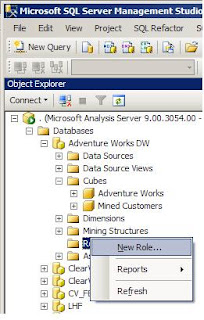
Basically you need to add a Role to the Analysis Services cube and add the ASPNET account as a member. Here's some screenshots showing the process in SSMS.
Connect to your cube and navigate to the 'Role' folder and right-click on it. Choose 'New Role...':
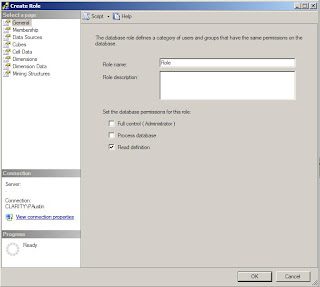
On the Create Role dialogue click the 'Full Control (Administrator)' box, and give it an appropriate name (for the purposes of this example we'll leave it as 'Role'):
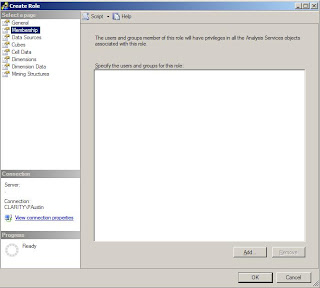
Click the 'Membership' property in the right-hand pane. Then click the 'Add...' button:
Type ASPNET as the object name and click 'Check Names' - it should underline it:
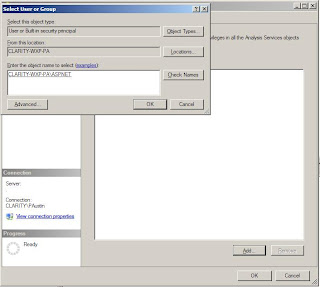
Click OK, and OK again on the 'Create Role' dialogue. Fire up the Dashboard Designer and you should find the Data Source connects fine.
Long story short, I came up against the problem detailed in full by Nick Barclay here. If you're running Vista or Windows 2003 you should read that post for the solution. However was I using XP.
Briefly, the problem was that creating a Data Source in the Dashboard Designer results in the following message:
"The PerformancePoint Server could not connect to the specified data source. Verify that either the current user or application pool user has Read permissions to the data source, depending on your security configuration. Also verify that all required connection information is provided and correct"
The reason for the message is that PerformancePoint is written in ASP.NET and as such, under IIS 6 it uses several Application Pools. Its the account that these app pools run under that is used to connect to a Data Source. Unfortunately XP uses IIS 5.1 so there's no app pools and therefore Nick's solution doesn't work. However there is a solution that I stumbled across.
On IIS 5 ASP.NET websites run under the ASPNET account. However, changing the priviliges (ie adding to the Administrators group) is bad practice and more fundamentally won't work. The solution is to give the ASPNET account priviliges on the target Data Source. This is easy enough for SQL Server - simply add the ASPNET account as a user and give it access to the relevant database. The Analysis Services solution is slightly more involved.
Basically you need to add a Role to the Analysis Services cube and add the ASPNET account as a member. Here's some screenshots showing the process in SSMS.
Connect to your cube and navigate to the 'Role' folder and right-click on it. Choose 'New Role...':

On the Create Role dialogue click the 'Full Control (Administrator)' box, and give it an appropriate name (for the purposes of this example we'll leave it as 'Role'):

Click the 'Membership' property in the right-hand pane. Then click the 'Add...' button:

Type ASPNET as the object name and click 'Check Names' - it should underline it:

Click OK, and OK again on the 'Create Role' dialogue. Fire up the Dashboard Designer and you should find the Data Source connects fine.
Friday, 7 March 2008
Details of Windows 2008/SQL 2008 performance emerging
Some pretty stellar performance being recorded for SQL 2008 on Windows 2008 on the SQL Server Performance Blog. Record ETL performance of over 2TB an hour! As they say themselves - not a certified benchmark but impressive nonetheless, and the sort of performance you'd expect of a data appliance and/or Informatica, Ab Initio et al. White paper to follow which should be an interesting read.
Some benchmarks that are certified on the other hand are the Transaction Processing Council (TPC). HP have posted the first 10TB TPC-H benchmark for Windows 2008/SQL Server 2008, achieving over 1000 queries per minute at less than $40 per query. Oracle and DB2 still do better at this scale - both in terms of raw performance and price/performance but SQL is catching up with every release. It'll be interesting to see the 3TB results because there wasn't much in it under SQL 2005.
Does any of this matter? Well yes and no. Clearly you're not going to embark on a 10TB data warehouse with only a handful of TPC benchmarks to guide you, but whereas previously you might not consider SQL Server for this scale I think its becoming more viable. Nationwide's Basel II data warehouse was predicted to get to that size a couple of years a ago and that was running on SQL 2005 and Windows 2003.
Some benchmarks that are certified on the other hand are the Transaction Processing Council (TPC). HP have posted the first 10TB TPC-H benchmark for Windows 2008/SQL Server 2008, achieving over 1000 queries per minute at less than $40 per query. Oracle and DB2 still do better at this scale - both in terms of raw performance and price/performance but SQL is catching up with every release. It'll be interesting to see the 3TB results because there wasn't much in it under SQL 2005.
Does any of this matter? Well yes and no. Clearly you're not going to embark on a 10TB data warehouse with only a handful of TPC benchmarks to guide you, but whereas previously you might not consider SQL Server for this scale I think its becoming more viable. Nationwide's Basel II data warehouse was predicted to get to that size a couple of years a ago and that was running on SQL 2005 and Windows 2003.
Friday, 29 February 2008
OLAP report BI survey released
The venerable OLAP Report has released the seventh annual BI survey for 2007. The report is reviewed here by Intelligent Enterprise. Not had the opportunity to read it - it's not exactly cheap at $4 995 for three users, hopefully Clarity will see fit to get the credit card out.
Some headlines however; customer 'loyalty' scores increased for Microstrategy, Applix and Microsoft Analysis Services and declined for Hyperion Essbase, Cognos and SAP.
Overall satisfaction with BI is high - 71% of survey respondents reporting that business goals had 'largely' been met.
On the flip-side less than 9% of employees use BI with cost and performance being the biggest obstacles to a wider deployment. 'BI for the masses' not exactly here yet...
Some headlines however; customer 'loyalty' scores increased for Microstrategy, Applix and Microsoft Analysis Services and declined for Hyperion Essbase, Cognos and SAP.
Overall satisfaction with BI is high - 71% of survey respondents reporting that business goals had 'largely' been met.
On the flip-side less than 9% of employees use BI with cost and performance being the biggest obstacles to a wider deployment. 'BI for the masses' not exactly here yet...
Thursday, 7 February 2008
Restating history or "What was the number on this date?"
Interesting article from Joy Mundy here about meeting the need to 'restate' history or do point-in-time analysis from a data warehouse. It involves joining on a business key which might raise a few eyebrows. Not sure how you'd go about doing this in an OLAP tool - a difficutly she highlights herself.
In a recent project I solved a similar problem by loading a snapshot of all relevant facts every day, and doing distinct counts in Analysis Services. A 'snapshot date' dimension allowed for analysis on any given date. This approach worked well because the data-sets were small (only amounting to 2000 rows a day) - Joy's might be a more elegant solution if you have millions of rows to contend with.
In a recent project I solved a similar problem by loading a snapshot of all relevant facts every day, and doing distinct counts in Analysis Services. A 'snapshot date' dimension allowed for analysis on any given date. This approach worked well because the data-sets were small (only amounting to 2000 rows a day) - Joy's might be a more elegant solution if you have millions of rows to contend with.
Monday, 4 February 2008
Conferences
Lots of SQL and BI events occuring over the next few months.
First-up is the Gartner Euro BI conference at which there will be a Clarity-Integration stand and some of my colleagues. Not me though unfortunately...
Second is the SQLBits II - The SQL in Birmingham next month. Puns aside its shaping up pretty well with sessions on 2008 as well as some in-depth 2005 sessions with MVPs. Only catch is that its on a Saturday. What gives with that?
Thirdly PASS Europe in April in Germany - not a lot of detail on this at the moment - although a couple of MVP's are doing sessions.
Last but certainly not least is the MS BI conference in Seattle in October. Went to this last year and it was great, with some informative and useful sessions - particularly from SQL CAT - oh and a free trip up the Space Needle courtesy of Panorama wasn't bad either...
First-up is the Gartner Euro BI conference at which there will be a Clarity-Integration stand and some of my colleagues. Not me though unfortunately...
Second is the SQLBits II - The SQL in Birmingham next month. Puns aside its shaping up pretty well with sessions on 2008 as well as some in-depth 2005 sessions with MVPs. Only catch is that its on a Saturday. What gives with that?
Thirdly PASS Europe in April in Germany - not a lot of detail on this at the moment - although a couple of MVP's are doing sessions.
Last but certainly not least is the MS BI conference in Seattle in October. Went to this last year and it was great, with some informative and useful sessions - particularly from SQL CAT - oh and a free trip up the Space Needle courtesy of Panorama wasn't bad either...
More useful blogs
Sometimes it amazes me how much good stuff people in the SQL community are blogging about. I for one have difficulty keeping up with it all. Stumbled across this by Michael Entin none other than the Tech Lead for SSIS - not someone I'd heard of I'm ashamed to say. Anyhoo lots of informative posts particularly about SQL 2008, including one about the improvement in multi-threading execution trees and another about compatability between VS2008/SQL2008 and VS2005/SQL2005 (note - there are limitations).
I found another detailed and interesting post here about Change Data Capture which could be really big news for BI on SQL2008 providing that a) your source system will be migrated onto 2008, and b) you can persuade your source system DBA's to switch it on. One of the major issues frequently encountered working with large source systems is figuring out the delta - ie whats changed since you last did an extract. Change Data Capture (CDC) could be a neat solution. Time to start bending your fellow DBA's ears now..
I found another detailed and interesting post here about Change Data Capture which could be really big news for BI on SQL2008 providing that a) your source system will be migrated onto 2008, and b) you can persuade your source system DBA's to switch it on. One of the major issues frequently encountered working with large source systems is figuring out the delta - ie whats changed since you last did an extract. Change Data Capture (CDC) could be a neat solution. Time to start bending your fellow DBA's ears now..
Subscribe to:
Posts (Atom)